From June 3 through 6, the MultiCASE team traveled to São Paulo, Brazil, for CBTOX 2026, an international gathering focused on toxicology, chemical safety, and emerging approaches to regulatory science.
During the conference, our scientists shared two presentations exploring how in silico methods can support more efficient, transparent, and scientifically defensible toxicity assessments. Topics ranged from established regulatory applications, including ICH M7 impurity evaluation, to emerging approaches for estimating compound-specific toxicity thresholds.
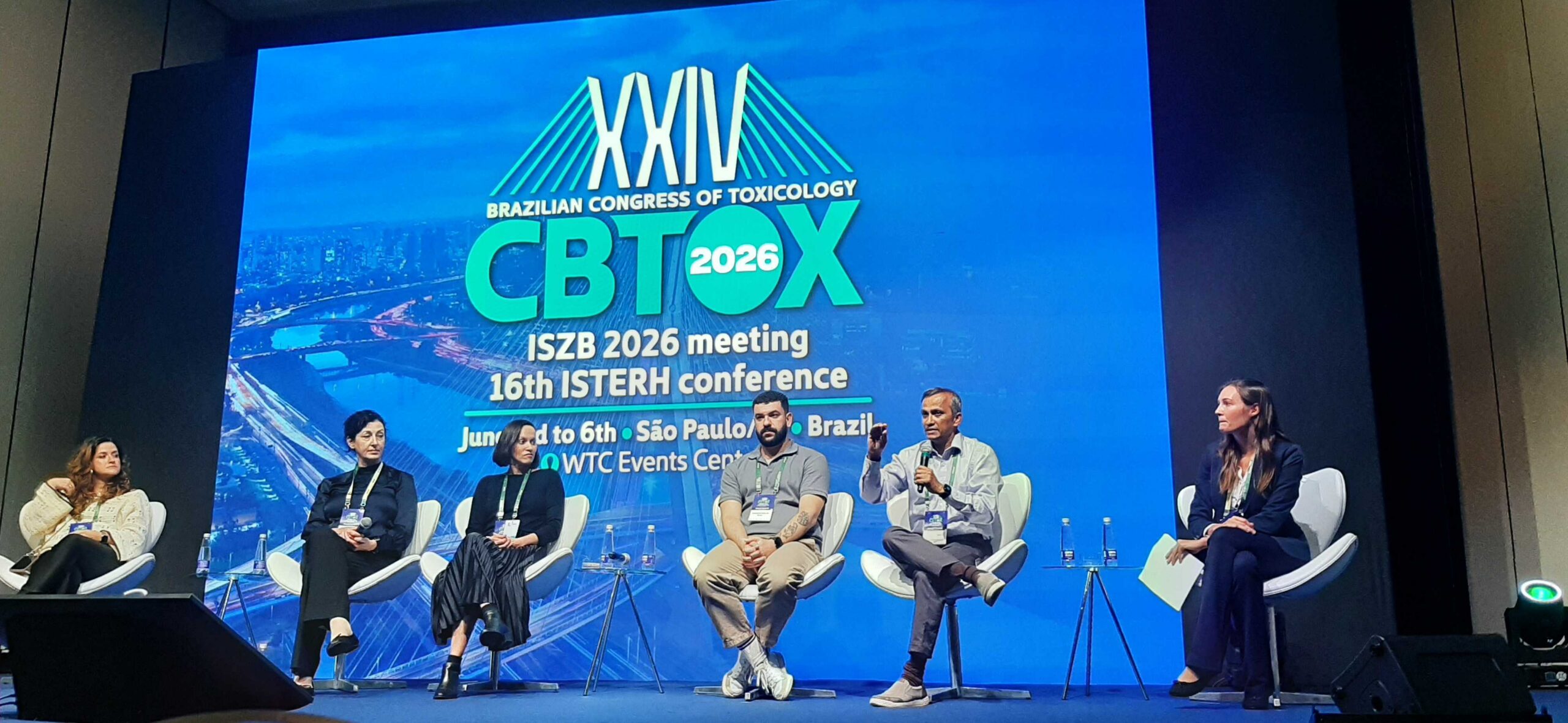
Dr. Krystle Reiss, Senior Research Scientist, and Dr. Suman Chakravarti, Vice President and Chief Scientific Officer, presented “MultiCASE In Silico Applications for Regulatory Submissions: Case Studies for the Pharmaceutical and Chemical Industries.”
The presentation provided an overview of how computational toxicology tools can support regulatory workflows across the pharmaceutical, medical device, consumer product, and chemical industries. Applications included impurity assessment, toxicity screening, analog identification, read-across, physicochemical property prediction, and expert review.
A major focus of the presentation was the use of CASE Ultra for bacterial mutagenicity assessment and expert review.
Under ICH M7, pharmaceutical impurities may be evaluated using two complementary (Q)SAR methodologies. The presentation demonstrated how statistical and rule-based expert models can be combined to generate transparent predictions, identify structural alerts, evaluate relevant analogs, and define the applicability domain of a prediction.
The presentation also highlighted the Konsolidator expert review tool, which allows users to examine alerts and supporting analog data, challenge initial model outcomes, and trace conclusions back to source information. This transparency can help strengthen the scientific justification included in a regulatory submission.
Beyond bacterial mutagenicity, the presentation explored additional CASE Ultra endpoints for genotoxicity and skin sensitization.
Examples showed how multiple complementary models and analog data can be reviewed together when individual predictions are inconclusive or outside the model domain. The skin sensitization workflow also demonstrated how expert models, statistical models, analogs, and potency categories can be combined to produce a more complete assessment.
This type of weight-of-evidence evaluation is especially valuable when a single prediction does not tell the entire story.
The second half of the presentation focused on applications available in QSAR Flex. These included:
The presentation demonstrated how nitrosamine assessment tools can help identify potential nitrosamines, evaluate the likelihood of their formation, estimate potency categories and acceptable intake limits, and locate relevant analogs with experimental data.
Dr. Chakravarti also presented “Data-Driven Approaches for Estimating Chemical Toxicity Thresholds.”
Traditional threshold of toxicological concern, or TTC, approaches often place diverse chemicals into broad structural categories. While these methods are useful for screening, broad classifications may overlook the structural and mechanistic differences that shape the toxicity of individual compounds.
The presentation introduced an alternative framework that uses experimental repeat-dose toxicity data, toxicity-relevant structural alerts, and mechanistically informed analog selection to estimate more compound-specific toxicity thresholds.
Structural similarity alone does not always make a chemical a useful analog.
Two compounds may appear highly similar while containing different toxicity alerts, missing an important alert, or introducing a new confounding feature. These differences can significantly affect toxicity.
The proposed framework, therefore, evaluates whether an analog shares both the structure and the specific mechanistic basis for toxicity with the target compound. It also compares physicochemical properties, experimental toxicity values, and alerts that are missing or newly introduced.
This creates a read-across process that is more transparent, reviewable, and directly connected to experimental LD50, no-effect level, and lowest-effect level data.
The presentation also emphasized that QSAR and read-across are complementary rather than competing approaches.
Read-across provides highly interpretable evidence from relevant analogs with experimental data, while QSAR models can rapidly analyze larger chemical spaces and generate predictions when close analogs are limited.
Toxicity alerts provide a shared mechanistic language between the two methods. Used together, QSAR and read-across can improve confidence, clarify uncertainty, and support more scientifically grounded toxicity thresholds.
CBTOX 2026 provided an excellent opportunity to connect with toxicologists, researchers, and regulatory professionals from Brazil and around the world.
We appreciate everyone who attended our presentations, visited with our team, and contributed to conversations about the future of predictive toxicology. As computational methods continue to evolve, we look forward to developing new approaches that make chemical safety assessments more efficient, interpretable, and scientifically robust.
To learn more about MultiCASE software, research, or consulting services, contact our team!